Calisthenics for Beginners: The Complete Bodyweight Workout Guide
Want to get fit without a gym membership or expensive equipment? Calisthenics is your answer. Learn the essential exercises, follow a proven beginner routine, and progress at your own pace — all from home with zero equipment.
Want a Personalized Calisthenics Plan?
Get a custom bodyweight workout plan tailored to your fitness level, goals, and available space. Powered by AI.
Generate My PlanWhat Is Calisthenics and Why Should You Start?
Calisthenics is a form of strength training that uses your own bodyweight as resistance. Think push-ups, squats, pull-ups, lunges, and planks — movements humans have used for centuries to build strength and fitness. Unlike gym workouts, calisthenics for beginners requires absolutely no equipment, no membership fees, and no commute. You can do it in your living room, a park, or a hotel room.
The beauty of calisthenics lies in its scalability. A push-up can be made easier (knee push-ups) or harder (archer push-ups, one-arm push-ups) depending on your level. This means calisthenics grows with you. As a beginner, you start with basic movements and gradually progress to more advanced variations — no weight increments needed.
Beyond convenience, calisthenics builds functional strength that translates directly to real-world movements. It improves your body awareness, balance, flexibility, and coordination in ways that machine-based gym training often doesn't. And research shows that bodyweight training can be just as effective as weight training for building muscle and strength in beginners.
The 6 Foundational Calisthenics Exercises
These six exercises form the core of any effective beginner calisthenics routine. Master these before attempting advanced movements like handstands or muscle-ups.
1. Squat
Target muscles: Quadriceps, hamstrings, glutes, core
The bodyweight squat is the foundation of lower body strength. Stand with feet shoulder-width apart, lower your hips as if sitting in a chair, keeping your chest up and knees tracking over your toes. Go as low as you can while keeping your heels on the ground.
Beginner goal: 3 sets of 15-20 reps
2. Push-Up
Target muscles: Chest, shoulders, triceps, core
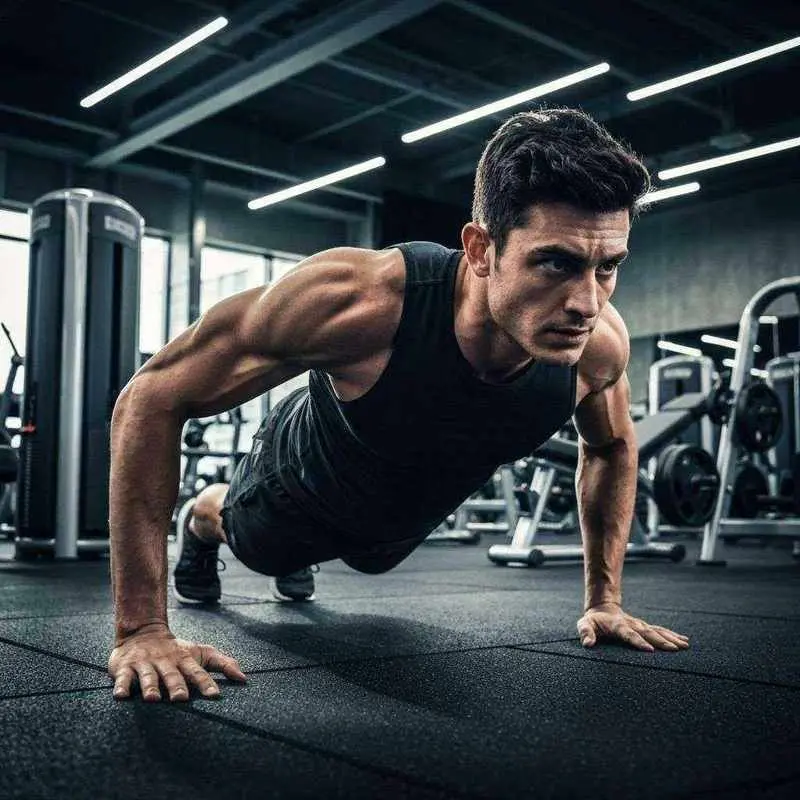
The push-up is the ultimate upper body pushing exercise. Start in a plank position with hands slightly wider than shoulder-width. Lower your chest to the ground, keeping your body in a straight line from head to heels, then push back up.
Beginner goal: 3 sets of 8-12 reps (use knee push-ups if needed)
3. Glute Bridge
Target muscles: Glutes, hamstrings, lower back
Lie on your back with knees bent and feet flat on the floor. Drive your hips upward, squeezing your glutes at the top. This exercise is crucial for building hip strength and counteracting the effects of prolonged sitting.
Beginner goal: 3 sets of 15-20 reps
4. Plank
Target muscles: Core, shoulders, lower back
The plank builds isometric core strength. Hold your body in a straight line on your forearms and toes, engaging your core and glutes. Don't let your hips sag or pike up.
Beginner goal: 3 sets of 30-45 second holds
5. Lunges
Target muscles: Quadriceps, glutes, hamstrings, calves
Step forward with one leg, lowering your hips until both knees are bent at about 90 degrees. Your front knee should be above your ankle, and your back knee should hover just above the ground. Alternate legs.
Beginner goal: 3 sets of 10-12 reps per leg
6. Bird Dog
Target muscles: Core, lower back, glutes, shoulders
Start on all fours. Simultaneously extend your right arm forward and left leg backward, keeping your hips and shoulders square. Hold briefly, then return to start and switch sides. This builds core stability and coordination.
Beginner goal: 3 sets of 8-10 reps per side
Sample Beginner Calisthenics Routine
Perform this full-body routine 3 times per week (e.g., Monday, Wednesday, Friday). Rest at least one day between sessions. Each workout takes about 30-40 minutes.
Workout A
- Squats: 3 sets × 15-20 reps
- Push-ups: 3 sets × 8-12 reps (knee push-ups if needed)
- Glute Bridge: 3 sets × 15-20 reps
- Plank: 3 sets × 30-45 seconds
Workout B
- Lunges: 3 sets × 10-12 reps per leg
- Incline Push-ups (hands on a table or chair): 3 sets × 12-15 reps
- Bird Dog: 3 sets × 8-10 reps per side
- Side Plank: 3 sets × 20-30 seconds per side
Important Notes
- Warm-up: 5 minutes of light jogging in place + arm circles + leg swings
- Rest between sets: 60-90 seconds
- Progression: When you hit the top of the rep range for all sets, move to a harder variation
- Cool-down: 5 minutes of static stretching for the muscles you worked
How to Progress in Calisthenics
The key to long-term success with calisthenics for beginners is progressive overload — just like with weights, you need to increase demand on your muscles over time. Here's how to do it without adding weight:
Increase Reps
The simplest method. If you can do 12 push-ups, aim for 13 next week. Keep adding reps until you can comfortably do 20-25, then move to a harder variation.
Harder Variations
Once basic exercises become easy, progress to more challenging versions:
- Push-ups: Knee → Standard → Wide → Diamond → Decline → Archer → One-arm
- Squats: Bodyweight → Pulse squats → Bulgarian split squats → Pistol squats (assisted)
- Plank: Standard → Extended arm → Leg raise → Side plank → Plank with taps
Slow Down the Tempo
Slowing down the eccentric (lowering) phase of each exercise increases time under tension, making even basic movements challenging. Try 3-4 second lowers on push-ups and squats.
Add Volume Gradually
Add one extra set per exercise or increase total workout frequency from 3 to 4 days per week. Listen to your body — add volume only when you recover fully between sessions.
Common Calisthenics Mistakes to Avoid
Sacrificing Form for Reps
Quality beats quantity every time. A perfect push-up with full range of motion is far more effective than 20 sloppy half-reps. If you can't maintain good form, regress to an easier variation.
Skipping Leg Work
Many calisthenics enthusiasts focus heavily on upper body (push-ups, pull-ups) while neglecting legs. Squats, lunges, and glute bridges are essential for balanced strength and preventing muscle imbalances.
Not Resting Enough
Calisthenics is still strength training. Rest 60-90 seconds between sets. Rushing through your workout reduces intensity and compromises your form on later sets.
Ignoring Core Work
A strong core stabilizes every calisthenics movement. Don't skip plank and bird dog exercises — they directly improve your performance on all other exercises.
Nutrition Tips for Calisthenics Success
Your body needs fuel to build strength and recover from workouts. Here's what to focus on:
Protein for Muscle Repair
Aim for 0.7-1 gram of protein per pound of bodyweight daily. Good sources: eggs, chicken, Greek yogurt, tofu, lentils, and protein shakes. Protein provides the amino acids your muscles need to repair and grow stronger.
Carbohydrates for Energy
Carbs fuel your workouts. Include rice, oats, potatoes, fruits, and vegetables in your diet. If you're training for muscle growth, eat slightly more than your maintenance calories.
Hydration
Drink water throughout the day. Dehydration reduces performance and recovery. Aim for at least 8-10 glasses daily, more on training days.
Conclusion
Calisthenics for beginners is the most accessible, practical, and effective way to start your fitness journey. No gym, no equipment, no excuses. With just your bodyweight and the six foundational exercises in this guide, you can build genuine strength, improve your physique, and develop the discipline that carries into every other area of your life.
Start with the basic routine, focus on perfect form, and progress when your body tells you it's ready. Consistency is everything — a 30-minute calisthenics workout done consistently will transform your body faster than a perfect plan you follow sporadically.
Ready to take it further? Generate a personalized calisthenics plan with GetFitAI's AI workout generator — tailored to your current fitness level, goals, and available space. Your bodyweight is all the weight you need.
Get Your Personalized
Calisthenics Training Plan
Our AI creates a custom bodyweight workout plan based on your fitness level, goals, and available space. Start your calisthenics journey today.
Generate Free Plan